The Headless Transmitter Revolution: Fly Pro for Less
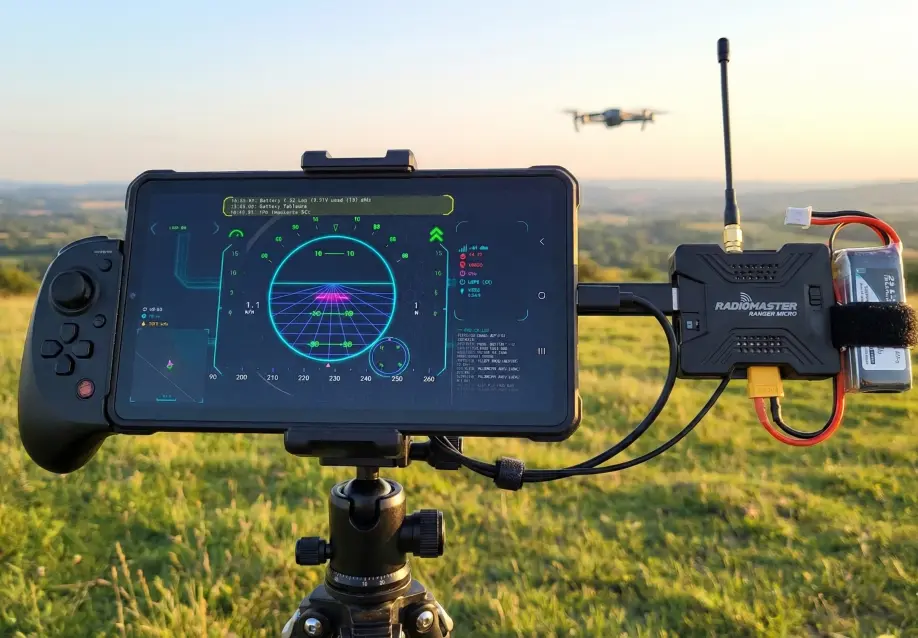
For years, the entry fee for professional long-range drone control has been steep—both in dollars and physical weight. The standard loadout involves buying a specialized, bulky RC radio like a Radiomaster TX16S for over $200. Then, because its 4-inch screen is too small for serious mission planning, you buy an Android tablet to run your Ground Control Station (GCS). You end up hiking up a mountain carrying two computers, two batteries, and a lot of redundant hardware.
It’s time to rethink the cockpit. We are proud to announce a major upcoming update to MAVLink HUD that introduces the "Headless Transmitter" concept: a way to fly professionally using the powerful computer you already own—your Android phone.
The Problem with Traditional Radios
Traditional radios are excellent engineering marvels, but they are relics of an era before everyone carried a supercomputer in their pocket. Think about the redundancy: your RC radio has a processor, a screen, a battery, and input sticks. Your phone also has a processor (one that is 100x faster), a screen (a stunning high-res OLED), and a battery.
Why pay for a dedicated low-res screen and a slow STM32 processor in your radio when your phone is already in your pocket? The traditional "box radio" creates a physical barrier between you and the experience, forcing you to look down at a tiny display or juggle a secondary tablet.
By decoupling the screen and sticks from the RF deck, we can build a modular, budget RC radio alternative that is lighter, cheaper, and infinitely more capable.
Architecture: The Android Drone Controller
The new architecture is simple yet revolutionary. It turns your device into a comprehensive Android drone controller that unifies control and telemetry into a single pane of glass:
- The Brains (Your Phone): Your Android phone running MAVLink HUD handles all the heavy lifting. It reads joystick inputs, mixes the channels, handles the telemetry stream, and renders the Augmented Reality interface.
- The Link (WiFi): The app connects via high-speed WiFi to a standalone ExpressLRS (ELRS) transmitter module. We utilize the high-bandwidth "Backpack" protocol to ensure low-latency command updates.
- The RF (The Module): The standalone RF module (like a Radiomaster Ranger Micro) does one thing and does it well: it broadcasts the ELRS packets to the drone.
This setup offers incredible flexibility that a traditional radio cannot match. You aren't tethered to the antenna. You can mount the high-power ELRS module on a tripod 20 feet away to clear tree lines for optimal signal propagation, connecting to it wirelessly via its internal WiFi backpack. You sit comfortably in the shade, with just your phone and controller, while your RF link sits high up in the clear air.
Game Controller FPV: Budget or Pro
We've completely rewritten our input engine to support standard USB and Bluetooth game controllers. This opens up two distinct paths for pilots, democratizing access to professional tools:
The Budget Route ($20)
For a low-cost bench setup or casual park flying, a simple $20 wired USB-C controller (like an 8BitDo Ultimate C) works perfectly. It’s the ultimate DIY RC transmitter hack. You get a solid reliable connection without breaking the bank, perfect for testing builds or letting friends try the simulator.
The Pro Route ($80)
For those demanding precision, mobile gaming grips like the Serafim S3, GameSir G8, or Backbone One transform your phone into a sleek handheld console. These modern controllers are not toys—many now feature high-quality Hall Effect joysticks that use magnetic sensors to eliminate stick drift, offering resolution that rivals professional $300 radios. You get the premium feel and precision control without the bulk of a box radio.
Innovation: Solving the Switch Problem
The biggest hurdle in flying a drone with an Xbox controller has always been the lack of physical switches. ArduPilot flight modes (Stabilize, Loiter, Auto, RTL) typically require 3-position toggles that gamepads simply don't have. Previous attempts to map these to buttons felt clunky and dangerous.
We've solved this with a software innovation we call "Sequential Gear Shifting." Our new "Virtual Switch" logic allows you to map a face button (like 'A' or 'X') as a modifier key.
EXAMPLE CONFIGURATION:
You are flying in Stabilize. You see a point of interest.
- 1. Hold the A button (acting as your "Clutch").
- 2. Pull the Right Trigger (your "Upshift").
- 3. The HUD announces "LOITER".
- 4. Need to come home? Hold A and tap Right Trigger again to shift into "RTL".
It feels natural, like shifting gears in a car. This provides full mission functionality on a standard gamepad, making modify game controller for drone use easier and safer than ever before.
Real World Use Cases
Who is this for? We see three main archetypes benefiting from this revolution:
- The Ultra-Light Hiker: Replace a 2lb radio and a 1lb tablet with just a phone grip and a tiny ELRS module. Save weight without sacrificing long-range reliability.
- The Urban Explorer: A full box radio draws attention. A guy playing on his phone with a backbone controller looks like he's just playing Genshin Impact. Fly stealthy.
- The Commercial Operator: You need redundancy and large maps. Using a 7-inch tablet as your primary controller gives you massive screen real estate for maps and video, something a TX16S can never offer.
Compatibility Checklist
Ready to build your setup? Here is the hardware you need to get ready for launch day:
- Android Device: A modern phone or tablet with USB OTG support (Android 10+ recommended).
- Controller: Any standard HID-compliant gamepad (Xbox, PlayStation, 8BitDo, Backbone, Razer Kishi).
- RF Module: A standalone ELRS transmitter module that supports WiFi and has an external power port (XT30).
- Recommended: Radiomaster Ranger Micro (Excellent cooling, up to 1 Watt output)
- Recommended: Radiomaster Nomad (Dual band gemini support)
- Portable: Radiomaster Ranger Nano (Smaller form factor)
This update is just around the corner. Get your standalone RF module charged up—the future of the drone ground station app is headless, wireless, and affordable.