Fly By Wire A (Plane)
Executive Summary
Fly By Wire A (FBWA) is the most popular stabilized flight mode for fixed-wing aircraft. It provides "Angle Control" for Roll and Pitch, meaning the stick position corresponds directly to the aircraft's bank/pitch angle. It is heavily safety-limited, preventing the pilot from rolling inverted or stalling the aircraft (if configured).
Theory & Concepts
1. Fly-By-Wire Architecture
In a standard plane, the cables move the surfaces. In a Fly-By-Wire system, the computer interprets your request and moves the surfaces for you.
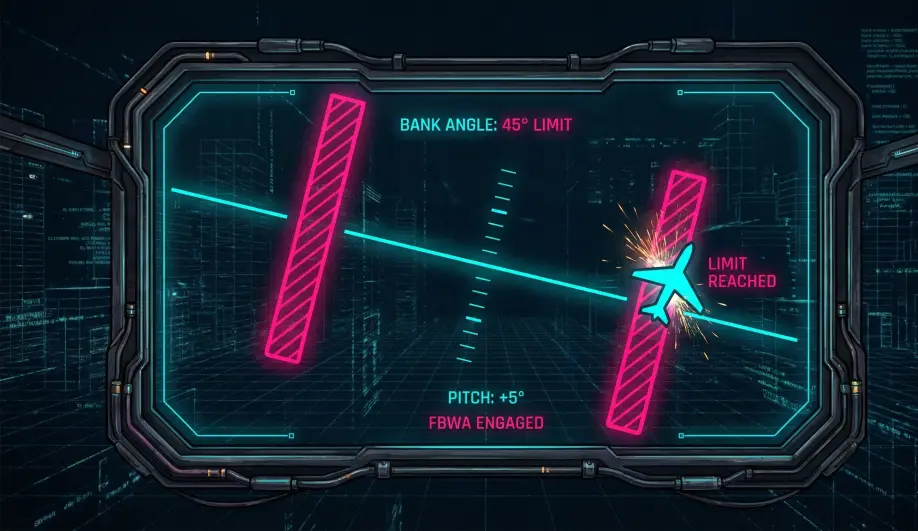
- Angle Limiting: The autopilot knows the Critical Bank Angle where a plane will lose lift. It forbids you from exceeding that angle, making it impossible to "Death Spiral" the aircraft in a turn.
- Self-Leveling: It is a "Low Pass Filter" for human error. If you jerk the stick, the autopilot smoothens the move. If you let go, it returns to center.
2. Stall Prevention Theory
A stall happens when the Angle of Attack (the angle between the wing and the oncoming air) is too high.
- The Problem: Most pilots pull "UP" on the elevator when they are scared. This increases the Angle of Attack and causes the stall.
- The Solution: ArduPilot's FBWA monitors the airspeed. If you are flying too slow, it limits your elevator authority. You can pull full back, and the plane will only pitch up a few degrees, forcing it to keep enough speed to stay in the air.
Hardware Dependency Matrix
FBWA requires accurate attitude estimation.
| Sensor | Requirement | Code Implementation Notes |
|---|---|---|
| Gyroscope | CRITICAL | Required for rate stabilization. |
| Accelerometer | CRITICAL | Required to determine "Level" and apply bank/pitch limits. |
| Airspeed | RECOMMENDED | Critical for Stall Prevention. Without airspeed, the controller cannot know if a high pitch angle is safe. |
| GPS | NONE | Not used. |
Control Architecture (Engineer's View)
FBWA operates as an Angle Controller with hard limits.
- Angle Mapping:
- Roll Stick: Maps to Bank Angle (
ROLL_LIMIT).- Full Left =
-ROLL_LIMIT(e.g., -45 deg). - Center = 0 deg (Level).
- Full Left =
- Pitch Stick: Maps to Pitch Angle.
- Full Back =
PITCH_LIMIT_MAX(e.g., +20 deg). - Full Forward =
PITCH_LIMIT_MIN(e.g., -25 deg).
- Full Back =
- Self-Leveling: Because center stick maps to 0 degrees, the plane automatically levels itself when you let go.
- Roll Stick: Maps to Bank Angle (
- Throttle Passthrough:
- Throttle is manual but constrained.
- Range is clamped between
THR_MINandTHR_MAX.
- Stall Prevention:
- If
STALL_PREVENTIONis enabled and an Airspeed sensor is present: - If airspeed drops below safe limits, the controller overrides the pilot's pitch input to lower the nose, maintaining flying speed. This happens even if you hold full back stick.
- If
Pilot Interaction
- Turning: Hold the aileron stick to the side. The plane banks to
ROLL_LIMITand turns. To stop turning, center the stick.- Note: You may need to pull back on the elevator to maintain altitude in a steep turn, just like a real plane.
- Climbing: Pull back. The plane climbs at a fixed angle. It does not maintain a specific climb rate (m/s), just a specific nose-up angle.
Failsafe Logic
- Attitude Loss: If the AHRS fails (bad accel calibration or vibration), FBWA cannot determine level and may roll the plane upside down thinking it is flat.
- Sensor Failure: If the Airspeed sensor fails, Stall Prevention may misbehave.
Key Parameters
| Parameter | Default | Description |
|---|---|---|
ROLL_LIMIT_DEG |
45 | Max bank angle (degrees). |
PITCH_LIMIT_MAX |
20 | Max pitch up angle (degrees). |
PITCH_LIMIT_MIN |
-25 | Max pitch down angle (degrees). |
STALL_PREVENTION |
1 | 0=Disabled, 1=Enabled. |
RLL2SRV_P |
... | Roll Angle P-gain. Determines how aggressively it seeks the target angle. |
Source Code Reference
- Mode Logic:
ardupilot/ArduPlane/mode_fbwa.cpp - Update Loop:
ModeFBWA::update()